
MPI
The Message Passing Interface is a communication protocol for programming parallel computers. Both point-to-point and collective communication are supported. Tolosa heavily relies on MPI to build its parallel environment. Several structures were created to make the communications’ implementation easier.
Collective communications
Section titled “Collective communications”Fortran structure
Section titled “Fortran structure”The mpi_pool structure defines a pool of MPI processes and basic operations on those processes. This structure enables collective communications inside a communicator.
TYPE mpi_pool
  integer(ip)              :: comm                ! Communicators Pool (mpi_comm_world for whole)  integer(ip)              :: size                ! Number of ranks in Pool  integer(ip)              :: rank                ! Rank Number from 0 to size-1  integer(ip)              :: err                 ! Usefull to test an error at output of an MPI routine  integer(ip), allocatable :: rankorder(:)  logical                  :: is_init = .false.
CONTAINS
  procedure, pass( self ) :: init      => mpi_init_  procedure, pass( self ) :: final     => mpi_final_  procedure, pass( self ) :: waitall   => mpi_wait_all  procedure, pass( self ) :: barrier   => mpi_wait_all  procedure, pass( self ) :: sum       => mpi_sum_  procedure, pass( self ) :: prod      => mpi_prod_  procedure, pass( self ) :: min       => mpi_min_  procedure, pass( self ) :: max       => mpi_max_  procedure, pass( self ) :: bcast     => mpi_bcast_
  procedure, pass( self ) :: mpi_allgather_i , mpi_allgather_r
  generic :: allgather => mpi_allgather_i , mpi_allgather_r
END TYPE mpi_pool
To initialize a pool of MPI processes, one has to call the mpi_init_ subroutine.
All the collective communications and collective operations are facilitated. The MPI operations enabling data communications (MPI_BCAST(), MPI_SCATTER(), MPI_GATHER(), MPI_ALLGATHER(), MPI_ALLTOALL()), data operations and communications (MPI_REDUCE(), MPI_ALLREDUCE()), and global synchronization (MPI_BARRIER()) are easily implemented in the following subroutines :
When the pool of MPI processes is no longer needed, one has to finalize MPI by calling the mpi_final_ subroutine.
To be able to use this structure, one has to initialize a the MPI environment with a new mpi_pool object first.
type(mpi_pool) :: mpi_world
[...]
call mpi_world%init
When the MPI pool is initialized, one can call specific operations. For example, one can gather all the processes’ rank in one table by writting :
integer              :: rankinteger, allocatable :: gath_rank(:)
type(mpi_pool) :: mpi_world
[...]
rank = mpi_world%rank
allocate( gath_rank( mpi_world%size ) )
call mpi_world%allgather( rank , gath_rank )
[...]
When the collective communications and operations are no longer needed, one can finalize MPI :
type(mpi_pool) :: mpi_world
[...]
call mpi_world%final
Point-to-point communications
Section titled “Point-to-point communications”Fortran structure
Section titled “Fortran structure”The mpi_mess structure represents a process with its rank, and other parameters used for the point-to-point communication. The mpi_com structure defines a point-to-point communication between two processes s and r. The mpi_com%pool points to a pool of MPI processes, previously defined as mpi_world ; this will enable one to identify the current process in the pool.
TYPE mpi_mess
  integer(ip)              :: rank   = 0_ip  integer(ip)              :: count  = 1_ip  integer(ip)              :: istart = 1_ip  integer(ip)              :: tag    = 0_ip  integer(ip)              :: typ_i  integer(ip)              :: typ_r  integer                  :: req  integer(ip)              :: err  integer(ip), allocatable :: d(:)  integer(ip), allocatable :: l(:)  integer(ip)              :: n  integer(ip)              :: typ
END TYPE mpi_mess
TYPE mpi_com
  type(mpi_pool), pointer :: pool => mpi_world  type(mpi_mess)          :: s  type(mpi_mess)          :: r  integer(ip)             :: err  logical                 :: twoside = .false.  logical                 :: is_init = .false.
  CONTAINS
  procedure :: equal_mpi_com
  procedure, pass( self ) :: reset             => reset_mpi_com  procedure, pass( self ) :: init              => initialize_mpi_com  procedure, pass( self ) :: replace           => replace_mpi_com  procedure, pass( self ) :: wait_send         => mpi_com_wait_send  procedure, pass( self ) :: wait_recv         => mpi_com_wait_recv  procedure, pass( self ) :: wait              => mpi_com_wait  procedure, pass( self ) :: regen_typ_to_send => mpi_com_regen_typ_to_send  procedure, pass( self ) :: regen_typ_to_recv => mpi_com_regen_typ_to_recv  procedure, pass( self ) :: regen_typ         => mpi_com_regen_typ
  procedure, pass( self ) :: mpi_com_send_scalar_i              , &                             mpi_com_send_scalar_r              , &                             mpi_com_recv_scalar_i              , &                             mpi_com_recv_scalar_r              , &                             mpi_com_send_array_i               , &                             mpi_com_recv_array_i               , &                             mpi_com_send_array_r               , &                             mpi_com_recv_array_r               , &                             mpi_com_send_recv_scalar_i         , &                             mpi_com_send_recv_scalar_r         , &                             mpi_com_send_recv_array_i          , &                             mpi_com_send_recv_array_r          , &                             mpi_com_gen_typ_to_send_indexed    , &                             mpi_com_gen_typ_to_recv_indexed    , &                             mpi_com_gen_typ_to_send_contiguous , &                             mpi_com_gen_typ_to_recv_contiguous
  generic :: assignment(=)   => equal_mpi_com  generic :: send            => mpi_com_send_scalar_i , &                                mpi_com_send_scalar_r , &                                mpi_com_send_array_i  , &                                mpi_com_send_array_r  generic :: recv            => mpi_com_recv_scalar_i , &                                mpi_com_recv_scalar_r , &                                mpi_com_recv_array_i  , &                                mpi_com_recv_array_r  generic :: send_recv       => mpi_com_send_recv_scalar_i , &                                mpi_com_send_recv_scalar_r , &                                mpi_com_send_recv_array_i  , &                                mpi_com_send_recv_array_r  generic :: gen_typ_to_send => mpi_com_gen_typ_to_send_indexed , &                                mpi_com_gen_typ_to_send_contiguous  generic :: gen_typ_to_recv => mpi_com_gen_typ_to_recv_indexed , &                                mpi_com_gen_typ_to_recv_contiguous
END TYPE mpi_com
When initializing the point-to-point communicator by calling the initialize_mpi_com subroutine, one has to define the ranks of the processes sending and receiving the data. If the data to be communicated is an array, and one wishes to send and receive only a portion of the array, one can enter the send_istart, recv_istart, send_count, recv_count values. If both processes need to send and receive data, one has to define twoside = .true. . A pool of MPI processes will also be defined ; if the pool is not specified at the initialization, a pool of all MPI processes will be defined.
When the communication is initialized, all point-to-point communications are facilitated. One can run blocking and non blocking communications. Non blocking communications are send and recv. Blocking communications are enabled by calling send_recv. One can also wait for the end of a non blocking communication by calling wait, wait_send, wait_recv.
To initialize a point-to-point communication between two processes ranked 0 and 1, one can write :
type(mpi_com) :: mpi
call mpi%init( send_rank = 0 , recv_rank = 1 )
One can choose to have a non-blocking communication to send an array by simply writting :
type(mpi_com)     :: mpireal, allocatable :: to_send(:)real, allocatable :: to_recv(:)
[...]
call mpi%send( to_send(:) )call mpi%recv( to_recv(:) )
[...]One can also have a blocking communication. Here, the process 0 is sending a scalar to the process 1 :
type(mpi_com) :: mpiinteger       :: a
[...]
call mpi%send_recv( to_send = a )If both processes are sending and receiving data to and from the other process, one should specify that the communication is on both sides, and send and receive data by writting :
type(mpi_com) :: mpiinteger       :: a_send, a_recv
[...]
call mpi%replace( twoside = .true. )
call mpi%send_recv( to_send = a_send , & to_recv = a_recv )Graph communications
Section titled “Graph communications”Fortran structure
Section titled “Fortran structure”The mpi_grph structure defines point-to-point communications in a graph of MPI processes.
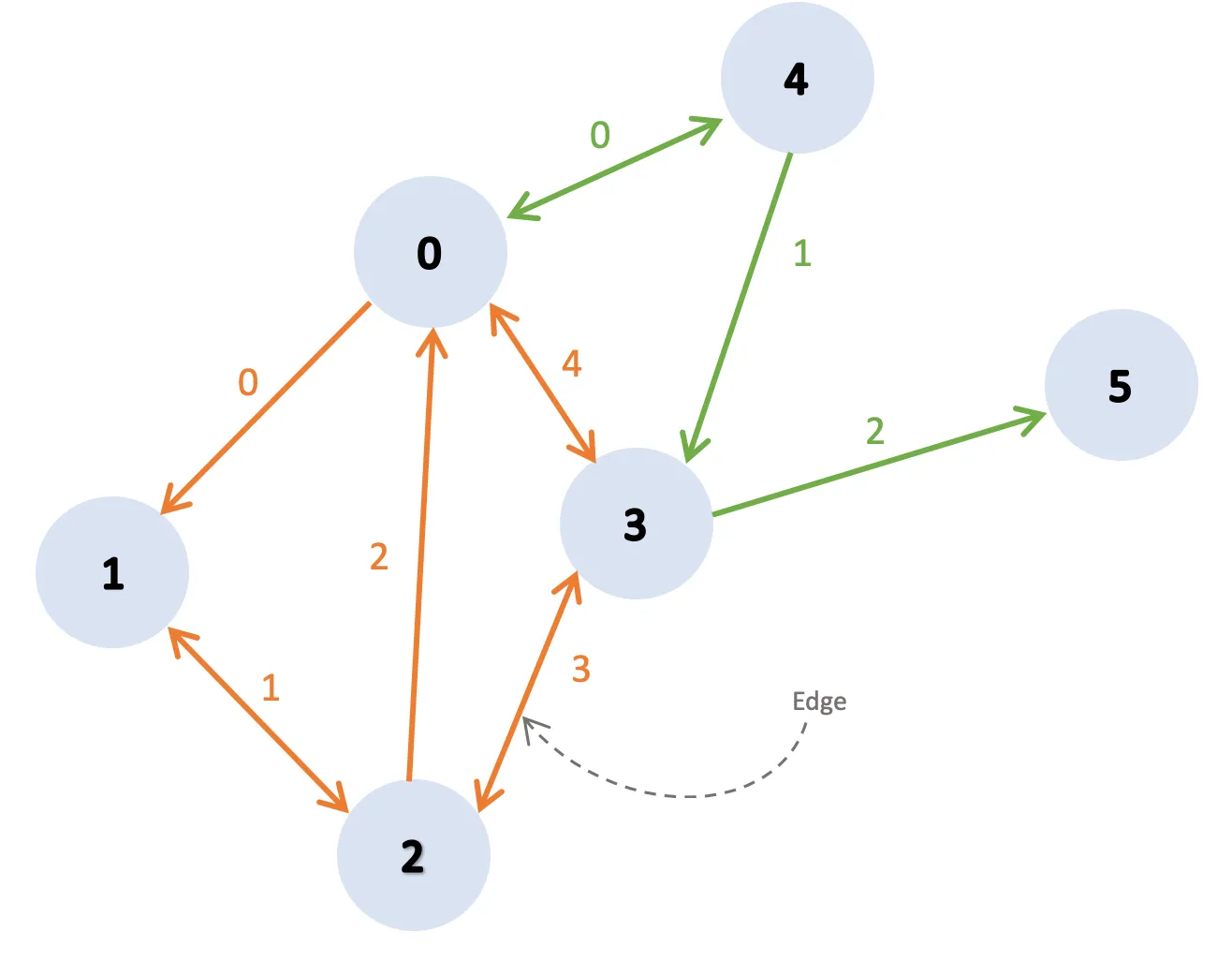
This image represents two graphs of MPI processes. The first graph contains the processes ranked 0, 1, 2, and 3. The second graph contains the processes ranked 0, 3, 4, 5. The mpi_grph structure is describing an MPI graph :
TYPE mpi_grph
  type(mpi_pool), pointer :: pool => mpi_world
  integer(ip) :: ne      ! Number of Edges (Two Sided Connected Ranks)  integer(ip) :: ne_send ! Number of Edges (One Sided Connected Ranks)  integer(ip) :: ne_recv ! Number of Edges (One Sided Connected Ranks)
  type(mpi_com), allocatable :: edge(:) ! Edges Array
  integer(ip) :: ireq
  logical :: is_init = .false.
CONTAINS
  procedure :: equal_mpi_graph
  procedure, pass( self ) :: init      => initialize_mpi_graph  procedure, pass( self ) :: wait_send => mpi_graph_wait_send  procedure, pass( self ) :: wait_recv => mpi_graph_wait_recv  procedure, pass( self ) :: wait      => mpi_graph_wait  procedure, pass( self ) :: regen_typ => mpi_graph_regen_typ
  procedure, pass( self ) :: mpi_graph_send_scal_i       , &                             mpi_graph_send_scal_r       , &                             mpi_graph_recv_scal_i       , &                             mpi_graph_recv_scal_r       , &                             mpi_graph_send_array_i      , &                             mpi_graph_send_array_r      , &                             mpi_graph_recv_array_i      , &                             mpi_graph_recv_array_r      , &                             mpi_graph_send_recv_scal_i  , &                             mpi_graph_send_recv_scal_r  , &                             mpi_graph_send_recv_array_i , &                             mpi_graph_send_recv_array_r
  generic :: assignment(=) => equal_mpi_graph  generic :: send          => mpi_graph_send_scal_i  , &                              mpi_graph_send_scal_r  , &                              mpi_graph_send_array_i , &                              mpi_graph_send_array_r  generic :: recv          => mpi_graph_recv_scal_i  , &                              mpi_graph_recv_scal_r  , &                              mpi_graph_recv_array_i , &                              mpi_graph_recv_array_r  generic :: send_recv     => mpi_graph_send_recv_scal_i  , &                              mpi_graph_send_recv_scal_r  , &                              mpi_graph_send_recv_array_i , &                              mpi_graph_send_recv_array_r
END TYPE mpi_grphTo use an MPI graph to enable communications between the processes, one should initialize the graph by calling the initialize_mpi_graph subroutine. One has to specify the number of two-sided connecting edges ne, and possibly a pool of processes to be targetted.
MPI graphs only enable non-blocking communications. One can communicate by using the send, recv, send_recv routines, and wait for the end of sending, receiving or both communications by calling respectively the wait_send, wait_recv and wait routines.
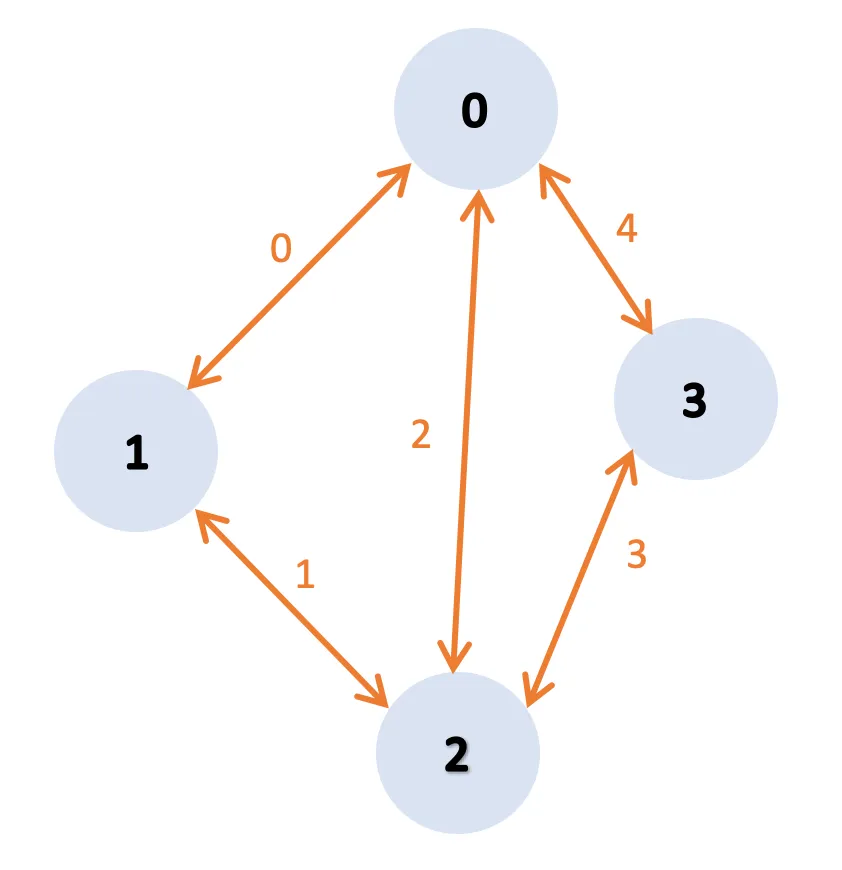 To initialize this MPI graph, one can write :
type(mpi_pool) :: mpi_worldtype(mpi_grph) :: mpi_graph
[...]
call mpi_graph%init( ne = 5 , pool = mpi_world )
Then, one can define the communicating processes contained in this graph. The edge variable is an array of point-to-point communicators (mpi_com).
call mpi_graph%edge( 0 )%init( send_rank = 0 , recv_rank = 1 , twoside = T )call mpi_graph%edge( 1 )%init( send_rank = 1 , recv_rank = 2 , twoside = T )call mpi_graph%edge( 2 )%init( send_rank = 0 , recv_rank = 2 , twoside = T )call mpi_graph%edge( 3 )%init( send_rank = 2 , recv_rank = 3 , twoside = T )call mpi_graph%edge( 4 )%init( send_rank = 3 , recv_rank = 4 , twoside = T )The following example shows the communication of global indexes of the mesh cells. Since the mesh is partitioned between each process, the mesh cells’ indexes are obviously different between processes.
type(msh) :: mesh
[...]
call mpi_graph%send_recv( mesh%cell(:)%glob  , withtmp = T )
[...]
This mpi_grph structure is fully used to handle communications between mesh partitions. See Mesh to further understand the use of this structure.