
Tutorial — Wave Breaking on a Slope
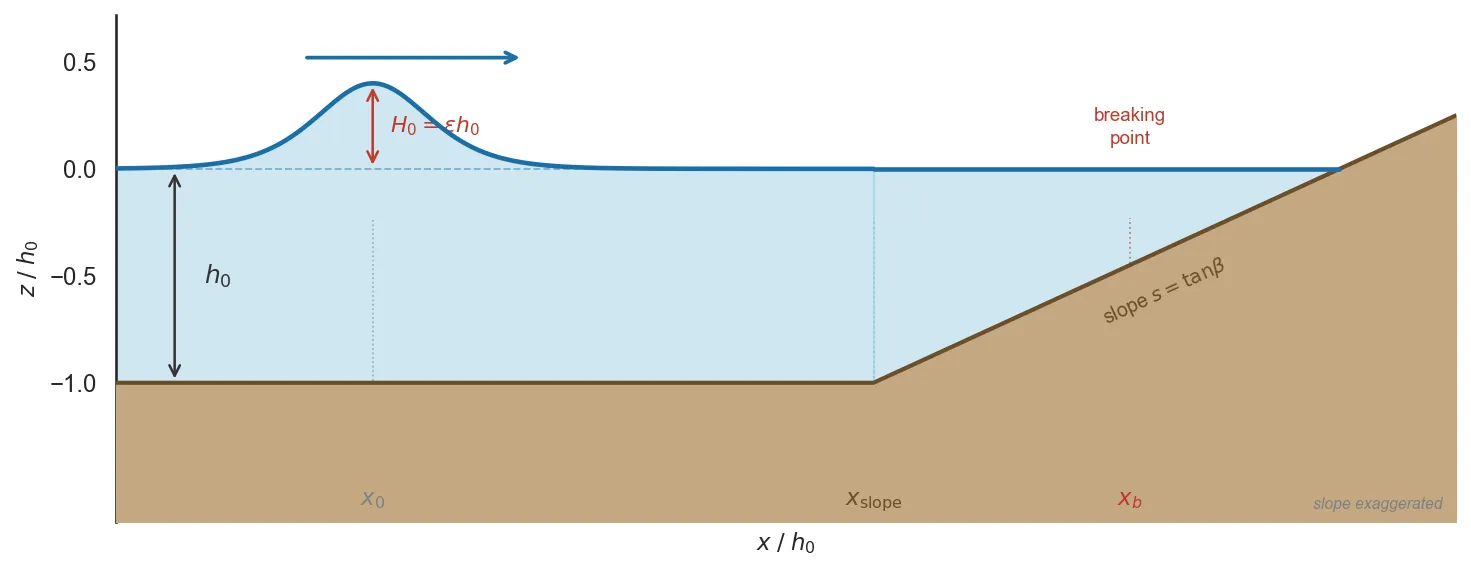
This tutorial goes one step beyond the Quick Start: instead of injecting a continuous wave train, you place a solitary wave on a flat bottom, let it shoal up a sloped beach, and capture the breaking event with Tolosa-lct’s enstrophy dissipation model.
The setup reproduces the benchmark of Grilli et al. (1997) — a well-documented FNPM (Fully Nonlinear Potential Model) reference used to validate nearshore wave models.
Expected runtime: ~30 seconds on 6 CPU cores (MPI, ~25 000 cells, ~38 500 time steps).
Reference: Grilli, S. T., Svendsen, I. A., & Subramanya, R. (1997). Breaking criterion and characteristics for solitary waves on slopes. JWPCOE 123(3), 102–112.
Prerequisites
Section titled “Prerequisites”Beyond the base requirements from the Quick Start, you need Python 3 with numpy, scipy, matplotlib, vtk, and gmsh:
pip install numpy scipy matplotlib vtk gmshPhysics background
Section titled “Physics background”A solitary wave of amplitude H₀ on a flat bottom of depth h₀ (ε = H₀/h₀) travels as a coherent structure. When it encounters a slope, it shoals: its height grows and its crest steepens. Past a critical point it breaks.
Grilli et al. measured the breaking location x′_b and breaking height H_b for 9 combinations of slope and amplitude. This tutorial uses case 100_eps40: slope s = 1:100, ε = 0.40 — a Spilling breaker (S₀ = 0.024 < 0.025).
The surf-similarity parameter S₀ classifies the breaking type:
| Type | S₀ range | Description |
|---|---|---|
| Spilling (SP) | < 0.025 | gradual foam on crest |
| Plunging (PL) | 0.025 – 0.30 | overturning jet |
| Surging (SU) | 0.30 – 0.37 | wave runs up without breaking |
The enstrophy model (wave_break_model = 2) detects breaking through the scalar enstrophy ψ and dissipates momentum in the breaking zone. Two parameters control it:
| Parameter | Value (slope 1:100) | Role |
|---|---|---|
Re_1 | 1.7 | inverse Reynolds number (dissipation intensity) |
psi_0_1 | 0.08 | enstrophy activation threshold |
These values are calibrated from Hung (2025, PhD ch. 4.1) against the Grilli data.
1. Copy the test case
Section titled “1. Copy the test case”All files for the Grilli campaign live in tests/surge/grilli/. Copy them to the run directory:
cd Tolosa-lctcp -r tests/surge/grilli/* bin/This places in bin/:
| File | Role |
|---|---|
run_grilli.py | orchestrates mesh, input, run, and plotting for all 9 cases |
cnoidal.py | generates the cnoidal/solitary initial wave field |
grilli_data/s*.dat | FNPM reference data from Grilli (1997) |
m_user_data.f90 | bathymetry + initial conditions (slope + solitary wave) |
input.txt | default simulation parameters |
2. Compile with wave breaking support
Section titled “2. Compile with wave breaking support”Wave breaking requires the enstrophy model to be compiled in. The mesh uses periodic BCs (bc_N/S = periodic), so PERIO=yes is also required:
cd Tolosa-lctmake SURGE=scalar PERIO=yes MPI=yes extlib # compile Scotch partitioner (once)make SURGE=scalar PERIO=yes MPI=yes C=gnu| Flag | Fields activated | Use case |
|---|---|---|
SURGE=scalar | φ (wave energy) + ψ (enstrophy) | This tutorial — enstrophy breaking |
SURGE=scalarw | φ only | Wave energy tracking without breaking |
SURGE=full | full tensors φ_ij, ψ_ij | Anisotropic breaking (reference model) |
3. Run with run_grilli.py
Section titled “3. Run with run_grilli.py”run_grilli.py handles everything: Gmsh mesh generation, input.txt configuration, soliton initialization, MPI execution, and comparison plotting.
cd binpython3 run_grilli.py setup run plot --case 100_eps40The three actions do the following:
setup — creates runs/100_eps40/ with:
domain.msh— Gmsh mesh (Lx = 124.5 m, dx = 0.05 m, periodic N/S)input.txt— configured for s = 1:100, ε = 0.40, ts = 48 srun.sh— MPI launch scriptgrilli_ref.dat— reference breaking data (x′_b, H_b/h_b, h_b/h₀)
run — calls cnoidal.py to generate the initial soliton field, then launches:
mpirun -np 6 ./exe -s 0.01 -x_slope 20.406 -x0 10.203 -ts 48.0 -dtw 0.480plot — reads the VTK snapshots, tracks the wave crest position at each frame, and generates runs/100_eps40/100_eps40_compare.png.
4. Results
Section titled “4. Results”Shoaling curve
Section titled “Shoaling curve”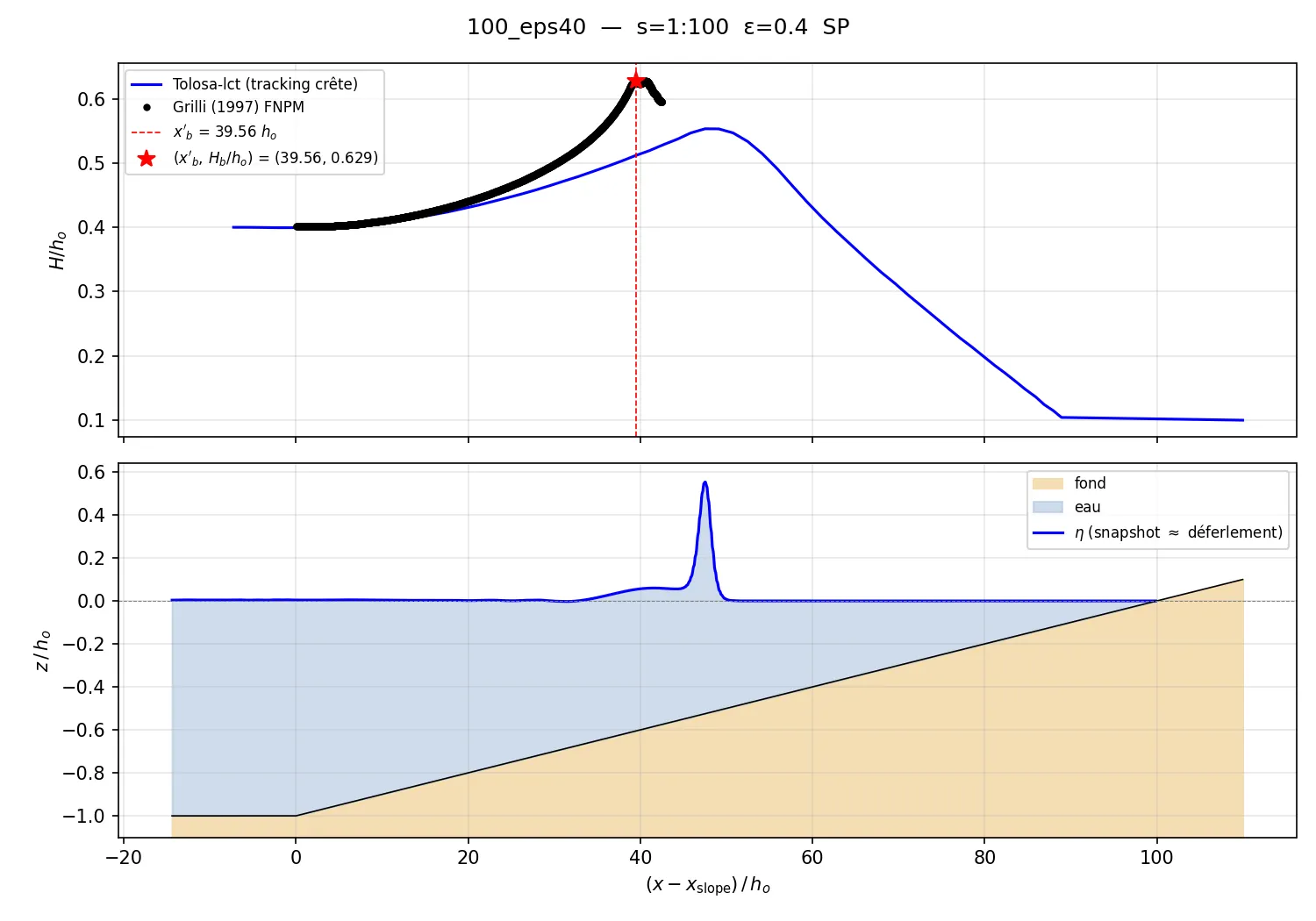
Top panel — H(x)/h₀. The blue curve tracks the spatial crest height at each output frame (VTK snapshot). Black dots are Grilli’s FNPM reference. The two agree well throughout the shoaling phase. The red dashed line marks x′_b = 39.56 h₀ (Grilli breaking point); without the wave breaking model (wave_break_model = 0), Tolosa-lct keeps growing past it — the SGN model captures the steepening but not the post-breaking energy dissipation.
Bottom panel — snapshot near breaking. The free surface (blue) is shown at the frame with maximum crest height. The slope rises from left to right; the sharp spike at x′/h₀ ≈ 47 is the SGN near-breaking structure just before the model diverges.
Breaking-point values for 100_eps40
Section titled “Breaking-point values for 100_eps40”| Quantity | Grilli FNPM | Notes |
|---|---|---|
| x′_b / h₀ | 39.56 | distance from slope toe at breaking |
| h_b / h₀ | 0.604 | water depth at breaking |
| H_b / h_b | 1.041 | height-to-depth ratio at breaking |
5. Key parameters in input.txt
Section titled “5. Key parameters in input.txt”run_grilli.py setup generates a case-specific input.txt. The parameters worth understanding:
! ── Mesh ────────────────────────────────────────────────────lx = 124.5       ! domain length [m] — flat bottom + slope + marginly = 0.5         ! thin channel (quasi-1D)nx = 2490        ! dx = 0.05 m (20 cells per h₀)ny = 11
bc_N = periodic  ! thin-channel trick: periodic N/S = quasi-1Dbc_S = periodicbc_W = wall      ! soliton reflects if it reaches the left wallbc_E = wall      ! slope extends to the right wall
! ── Time stepping ────────────────────────────────────────────cfl    = 0.2     ! conservative for the shoaling wavecfl_ac = 0.8     ! acoustic sub-step CFLmach   = 0.2     ! acoustic speed = √(gh₀)/mach
! ── Wave breaking ────────────────────────────────────────────wave_break_model = 0     ! 0 = off, 2 = enstrophy model (Hung 2025)Re_1             = 1.7   ! calibrated for slope 1:100psi_0_1          = 0.08
! ── Slope geometry (passed as CLI args to exe) ───────────────s        = 0.01          ! tan(β) = 1/100x_slope  = 20.406        ! x-coordinate of slope toe [m]x0       = 10.203        ! initial soliton crest position [m]ts       = 48.0          ! simulation duration [s]
Two-run strategy: the setup generates wave_break_model = 0 (off) to see the pure SGN shoaling behaviour and compare with FNPM before the breaking point. To activate the dissipation model, edit runs/100_eps40/input.txt, set wave_break_model = 2, and re-run:
python3 run_grilli.py run plot --case 100_eps40No recompile is needed — wave_break_model is a runtime parameter.
6. What m_user_data.f90 does
Section titled “6. What m_user_data.f90 does”Bathymetry — flat bottom at −h₀ = −1 m, then a smooth slope starting at x_slope:
bathy_user = -H_wave + s * 0.5_rp * ( xi + sqrt( xi*xi + r_slope*r_slope ) )The r_slope term rounds the toe of the slope (radius 0.05 m), avoiding a sharp corner that would generate spurious reflections.
Initial conditions — the soliton profile from cnoidal.bin (written by cnoidal.py) is interpolated onto the mesh. The soliton is centered at x0; the flat-water state (h = h₀, u = 0) is applied outside the soliton footprint.
No boundary injection — bc_user is unused. The soliton is already in the domain at t = 0; there is no wave maker.
7. Visualize in ParaView
Section titled “7. Visualize in ParaView”- File → Open →
runs/100_eps40/res/vtk/→ selectresult_000000.vtk(series auto-detected). - Click Apply.
- Color by
ssh— you’ll see the soliton hump traveling right and growing as it shoals. - Switch to
psi(enstrophy) — whenwave_break_model = 2is active, the breaking zone lights up as the wave steepens past the threshold.
8. Run all 9 cases
Section titled “8. Run all 9 cases”Drop --case to run the full 3 × 3 matrix (three slopes × three amplitudes):
python3 run_grilli.py setup run plotEach case produces its own runs/<name>/<name>_compare.png with the shoaling curve vs FNPM reference. The calibrated breaking parameters per slope (from Hung 2025) are applied automatically.
| Case | s | ε | S₀ | Type |
|---|---|---|---|---|
100_eps20 | 1:100 | 0.20 | 0.0340 | PL |
100_eps40 | 1:100 | 0.40 | 0.0240 | SP |
100_eps60 | 1:100 | 0.60 | 0.0196 | SP |
35_eps20 | 1:35 | 0.20 | 0.0972 | PL |
35_eps40 | 1:35 | 0.40 | 0.0687 | PL |
35_eps60 | 1:35 | 0.60 | 0.0561 | PL |
15_eps30 | 1:15 | 0.30 | 0.1851 | PL |
15_eps45 | 1:15 | 0.45 | 0.1512 | PL |
15_eps60 | 1:15 | 0.60 | 0.1309 | PL |
Next steps
Section titled “Next steps”- Calibrate for other slopes — change
Re_1/psi_0_1using the slope-dependent law from Hung (2025):Re_1 = 1 + 75 · tan(β)psi_0_1 = 0.0909 · (1 + tan(β))^(−30.78) + 0.0123 - Periodic wave breaking —
tests/surge/watanabe_perio/runs a cnoidal wave on a flat periodic domain to validate the enstrophy dissipation rate in a statistically steady state.